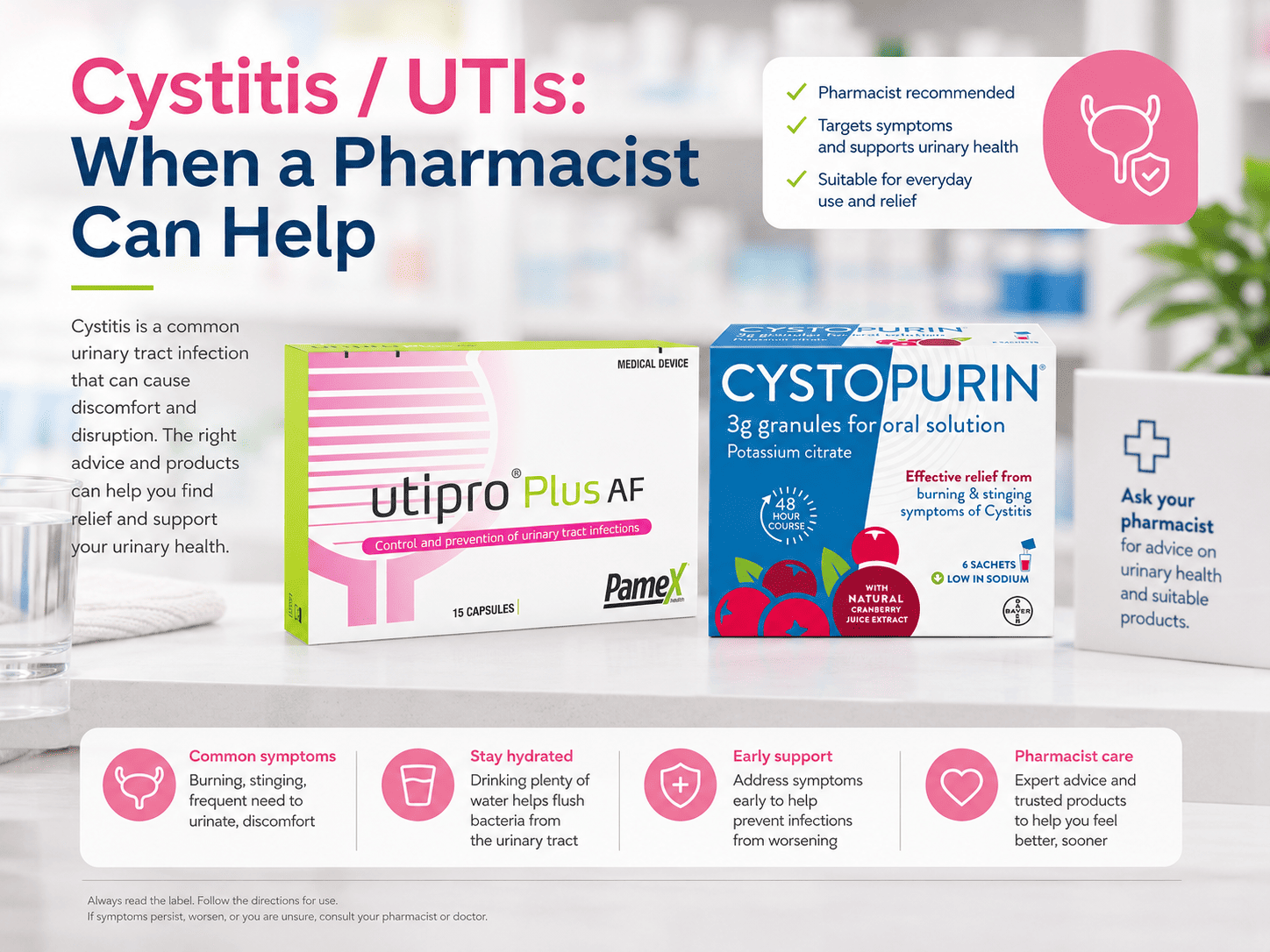
That first sting when you go to the loo, then the feeling you need to go again two minutes later. If you have had cystitis, you know it the second it starts. It is one of the most common things we get asked about at the counter, and the good news is most cases settle quickly once you do the right things. Here is what is actually going on, how to tell it apart from other issues, and when you genuinely need to be seen.
Cystitis or UTI, what is the difference?
People use the two words for the same thing, and most of the time that is fine. Cystitis just means the bladder is inflamed and irritated. Usually that is down to a urinary tract infection, where bacteria, most often E. coli from your own gut, get into the bladder. E. coli is behind roughly 75 to 90 percent of these infections [1].
It is very common, especially in women. About half of all women get at least one UTI in their lifetime, and around one in three have had one treated by the age of 24 [2]. The reason is plain plumbing. A woman’s urethra is short, so bacteria have a shorter trip to the bladder.
Is it actually a UTI? How to tell it apart
This is the bit people get wrong. A burning wee does not always mean a UTI, and treating the wrong thing just wastes time. Here is a quick guide to what tends to point where. If you are not sure, ask us or your GP.
| What you notice | More likely to be |
|---|---|
| Burning or stinging when you pee, going often and urgently, low tummy ache, cloudy or strong smelling urine | Cystitis / UTI |
| Itch and soreness on the outside, thick white discharge like cottage cheese, stinging as urine passes over sore skin | Thrush |
| Thin grey discharge with a fishy smell, little or no pain | Bacterial vaginosis |
| Burning plus unusual discharge, especially with a new partner | An STI (chlamydia and gonorrhoea can copy a UTI, so get tested) |
| Bladder pain and urgency for weeks or months, but urine tests keep coming back clear | Bladder pain syndrome (interstitial cystitis) |
| Rushing to the loo often, but no pain and no infection found | Overactive bladder |
| Fever, pain in your back or side, shivering, feeling sick or genuinely unwell | A kidney infection, which is urgent (see below) |
What to do first for a mild bout
If you are otherwise well and it is a straightforward flare, a lot of it settles on its own within a few days. Plenty of uncomplicated UTIs in women clear up without antibiotics [3]. While it does, you can take the edge off.
- Drink more water. It flushes the bladder and dilutes your urine so it stings less.
- Pain relief. Paracetamol or ibuprofen, taken as directed, ease the ache and the burning. Pop in and we will check what suits you.
- Citrate sachets. Potassium or sodium citrate sachets make urine less acidic and a bit more comfortable for a day or two. The evidence is thin, so treat them as comfort rather than a cure [4].
- Do not hold it. Go when you need to, and empty fully each time.
What the research actually says about the popular remedies
There is a lot of noise online, so here is the honest version from the recent trials.
- Cranberry. This one has turned a corner. A 2023 Cochrane review of more than 50 studies found cranberry products do lower the chance of repeat UTIs in women who get them often [5]. It is for prevention, not for treating an infection you already have.
- D-mannose. It looked promising, but the large 2024 MERIT trial found it did not really beat a dummy at preventing recurrent UTIs [6]. Not the magic bullet it was sold as.
- Methenamine hippurate. For women who get frequent infections, the 2022 ALTAR trial found this non-antibiotic option worked about as well as daily preventive antibiotics [7]. Worth raising with your GP if that is you.
- Vaginal estrogen. After menopause, lower estrogen makes UTIs more likely, and a prescribed vaginal estrogen can cut how often they come back.
Do you need antibiotics?
Not always, and that is on purpose. Overusing antibiotics is how bacteria learn to resist them, so the modern approach is to treat the infections that need it and support the rest. When a simple bladder infection in a woman does need an antibiotic, the usual first choice in Ireland is nitrofurantoin, as a short three day course [8]. Trimethoprim used to be first line, but resistance has climbed, so it has slipped down the list.
You cannot buy these over the counter, and you should not want to. But you do not always need a GP appointment to get going, because our Common Conditions Service can assess you right here in the pharmacy.
Stopping the next one
- Keep your fluids up across the day.
- Pee soon after sex, and wipe front to back.
- Do not hang on when you need to go, and empty fully.
- Go easy on heavily perfumed soaps and bubble baths around that area.
- If you get them often, give a daily cranberry a fair trial, and postmenopausal women should ask about vaginal estrogen.
What our staff say at the counter
- The 30 second version: Push the fluids and take paracetamol or ibuprofen for the pain. If you feel one starting, a short course of Utipro Plus AF can help, and if you get them often, a daily cranberry like Cystopurin is your prevention. If it is not easing within a day or two, or you have a fever, back pain, blood, or you are pregnant, come straight back or see your GP.
- Utipro or Cystopurin, what is the difference? Cystopurin Cranberry is a daily sachet for long term prevention, it helps stop bacteria sticking to the bladder. Utipro Plus AF is a capsule you take as a short course when symptoms start, or to head off flare-ups, and it works a different way using hibiscus and a protective film in the gut. Simple rule: Cystopurin for daily prevention, Utipro when one is brewing.
- First thing we check: Any fever, back or side pain, blood, pregnancy, or is it a man or a child? If yes, that is not one to self treat and we will point you to be seen.
- The honest bit: We will tell you when we think you need antibiotics, and just as importantly, when you do not.
What we would reach for
Two products come up most often, and they do different jobs, so it helps to know which is which.
Cystopurin Cranberry is a daily cranberry sachet for prevention. The cranberry helps stop bacteria clinging to the bladder wall, and it is the option with recent trial evidence behind it for people who get UTIs often. Take it day to day.
Utipro Plus AF is a capsule you take as a short course when you feel one starting, or to head off flare-ups. It works differently to cranberry, using a hibiscus extract and a protective film in the gut that limits bacteria getting through. Reach for this one at the first sign.

Also worth knowing about: citrate sachets (sold as Cymalon, CanesOasis and similar) can ease the sting for a day or two while a mild bout settles. D-mannose gets a lot of hype, but the latest trial was underwhelming, so we would not spend big on it. Ask us in store and we will steer you to what actually helps. If you get UTIs often, a cranberry-probiotic such as Bio Kult Pro-Cyan is another option worth knowing about, and our probiotics guide explains how to choose one.
You may not need a GP: our Common Conditions Service
Through Ireland’s Common Conditions Service, our pharmacists can assess and treat uncomplicated UTIs in women aged 18 to 65 right here in the pharmacy, with no GP appointment or referral needed. You just walk in and ask for the service at the counter. A pharmacist assesses your symptoms privately in our consultation room, and where it is appropriate we can supply treatment on the spot. If it needs a doctor, we will tell you honestly and point you the right way.
It is a 10 minute private consultation with a €35 consultation fee, payable at the pharmacy. Not sure whether it is something we can treat? Call us on 057 86 61999 and we will talk you through it.
References
- Flores-Mireles AL, et al. Urinary tract infections: epidemiology, mechanisms of infection and treatment options. Nat Rev Microbiol. 2015.
- Foxman B. Urinary tract infection syndromes: occurrence, recurrence, epidemiology. Infect Dis Clin North Am. 2014.
- NICE NG109. Urinary tract infection (lower): antimicrobial prescribing. 2018.
- NICE Clinical Knowledge Summaries. Urinary tract infection (lower), women. 2023 update.
- Williams G, et al. Cranberries for preventing urinary tract infections. Cochrane Database of Systematic Reviews. 2023.
- Hayward G, et al. D-mannose for the prevention of recurrent UTI (MERIT randomised trial). JAMA Internal Medicine. 2024.
- Harding C, et al. Methenamine hippurate compared with antibiotic prophylaxis for recurrent UTI (ALTAR). BMJ. 2022.
- HSE and antibioticprescribing.ie. Guidance on urinary tract infection, Ireland.