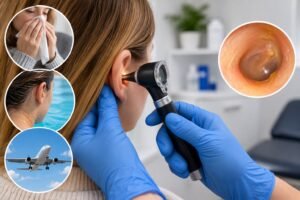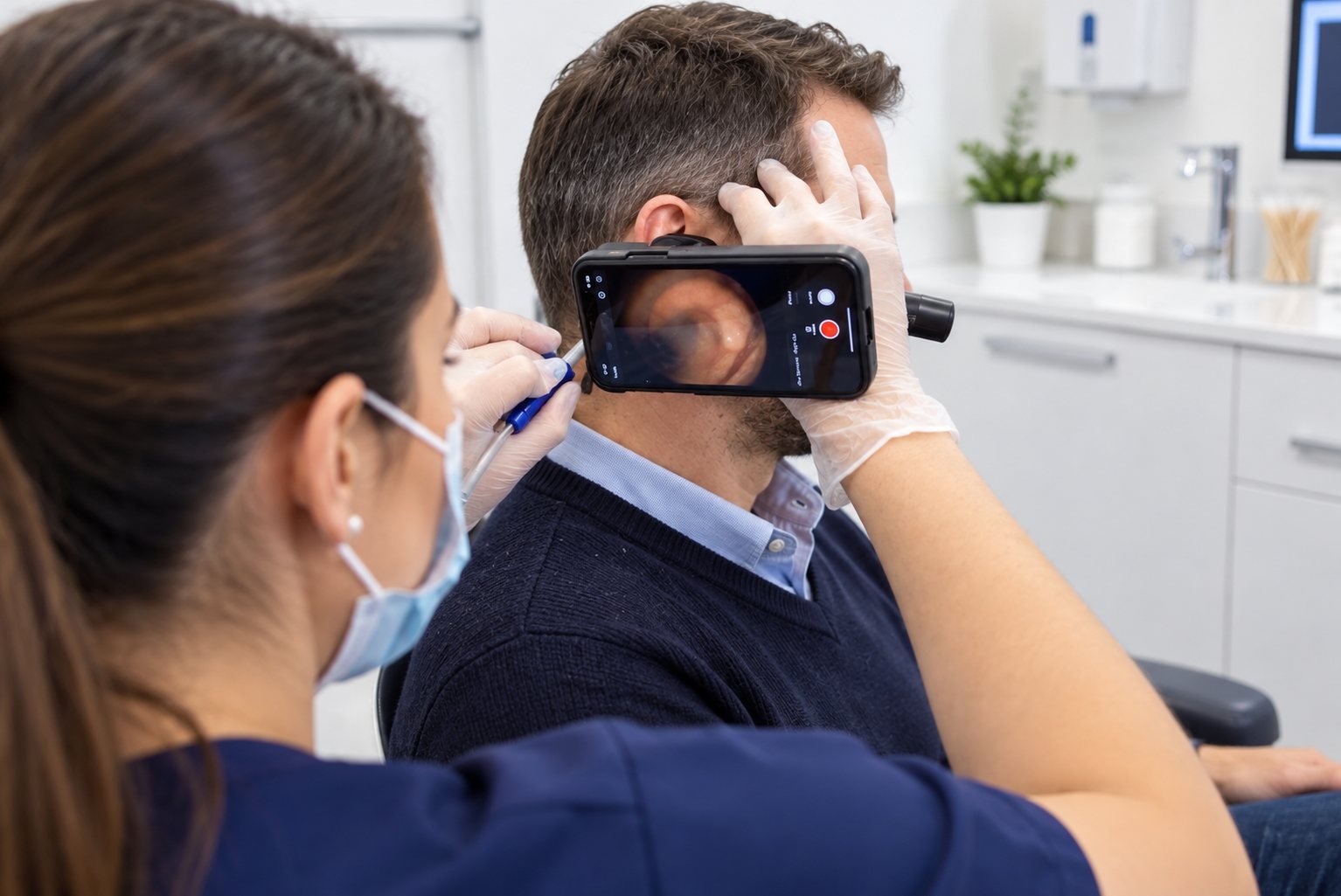
- An appointment starts with health questions, a look in your ear and an explanation of what to expect.
- Wax is drawn out with a fine suction tip while the ear canal is viewed under magnification.
- Expect a loud rushing noise, a cool feeling and possibly some dizziness or a cough.
- Very hard wax may need more softening and a second visit.
Before your appointment: softening the wax
A 2023 review in the British Journal of General Practice notes that NICE recommends softeners for up to five days before removal. ENT UK says drops beforehand may help the wax to clear, although they are not usually needed when the person doing it is experienced and well equipped.
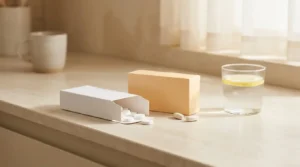
The HSE method for softening wax at home is:
- Lie on your side with the affected ear facing up.
- Put in two to three drops of olive oil or almond oil.
- Stay lying on your side for five to 10 minutes.
- Repeat three to four times a day for three to five days.
We stock Ultrapure olive oil 100ml (€5.95), and our guide to olive oil for ear wax has more detail. The HSE says not to use drops if you have a hole in your eardrum, and not to use almond oil if you are allergic to almonds.
The British Society of Audiology (BSA) says your ear may feel more blocked for a while because the wax swells. If you wear hearing aids, it suggests using the oil overnight, as oil can affect an aid if it gets inside. Leave the cotton buds alone too, as the HSE says they push wax further in (more on cotton buds, ear candles and ear vacuums).
Step one: health questions and consent
At our ear wax removal in Portlaoise service, appointments take place in a private consultation room. They are carried out by members of the team trained and certified in micro-suction, with a pharmacist on site for every appointment.
You start with questions about your ears and health, because BSA guidance says some conditions change whether, or how, wax should be removed. These include:
- a hole in your eardrum, grommets or ear surgery
- recent ear infections, discharge or ear pain
- blood-thinning medicines
- diabetes, or high or low blood pressure, as light-headedness can add to dizziness
- a dry or tickly throat, or difficulty keeping your head still
ENT UK says the process, what it is likely to feel like and the possible risks should be fully discussed before starting. The BSA says you must give informed consent, written or spoken, so ask anything you are unsure about.
Step two: looking in the ear and the suction
Your ear canal and eardrum are checked with an otoscope, a small light with a magnifier. The BSA says the ear can be checked this way throughout the procedure.
ENT UK says microsuction can be done lying down or sitting in a chair. A fine suction tip is guided into the canal under magnification, usually a microscope, although some practitioners use magnifying loupes or a rigid endoscope.
ENT UK says the suction can take from a few seconds to 20 minutes, depending on how much wax there is, how hard it is, the shape of your canal and the experience of the person doing it. The BSA says that, once wax is softened enough, clearing both ears should take no longer than about half an hour on average.
What microsuction feels like
| What you might notice | Why it happens |
|---|---|
| A loud rushing sound | ENT UK describes the suction as loud, with some reports suggesting up to 140 decibels. Thin sheets of wax can make a particularly loud, high-pitched sound in the suction tip. |
| A cool feeling | A York Hospital NHS leaflet says the rushing air can feel cool. |
| Some dizziness | ENT UK says this is common, as air drawn out of the canal changes its temperature. |
| A cough | Touching the canal skin can stimulate the vagus nerve. |
| Some discomfort | Not unusual if wax is stuck deep in the canal, where the skin is very sensitive. |
ENT UK says fainting is extremely rare, and the York leaflet notes the procedure can be stopped at any point.
Possible risks listed by ENT UK include injury to the skin of the ear canal (about one in 20), seen as more pain than expected or bleeding, which usually settles within seconds or minutes once suction stops, and temporary tinnitus (about one in 100). ENT UK notes these figures are estimates based on experience.
If the wax will not all come out
ENT UK says that, on rare occasions, a blockage cannot be cleared at the first visit. It advises against carrying on if it becomes painful, and recommends softeners and a further appointment instead.
The BSA says softener can be used for up to another five days, although it may only reach the outer layers of a long or very hard plug. The York leaflet says some people need one visit while others need to come back.
Book a microsuction appointment in Portlaoise
From Monday 9 November 2026, ear wax removal costs €50 for both ears or €40 for one ear. The €20 online booking fee is taken off the price on the day, and if no wax is found, the €20 covers your ear check. Appointments run Monday to Saturday, 10am to 1pm and 3pm to 5pm, for ages 16 and over. We are close to the M7 and M8, and easy to reach from across Laois, Kildare, Offaly, Carlow and Kilkenny.
After your appointment
You may feel unsteady straight afterwards, so the BSA advises against sitting up or standing up too quickly. It also says wax may build up again and need further care later.
Hearing aid wearers are more likely to have impacted wax, according to the York leaflet. Our guide to microsuction vs ear syringing compares the two.
When to see your GP
The BSA checklist says suction should not go ahead with a perforation or a grommet now or in the last 90 days. No wax removal method should go ahead, and medical advice should be sought instead, if you have had:
- ear surgery
- a middle ear infection now or in the last six weeks
- a mucus discharge from the ear in the last 12 months
- significant ear pain in the last 90 days that does not seem to be caused by wax
The HSE advises seeing your GP if symptoms have not cleared after five days, or if your ear is badly blocked and you cannot hear properly. The NHS advises an urgent GP appointment for sudden hearing loss in one or both ears, so contact your GP or a GP out-of-hours service promptly.
After wax removal, the BSA says to contact your GP as soon as possible if you get discomfort, pain, swelling, discharge or a smell from the ear, or any change in hearing, balance or tinnitus. Our service is for ages 16 and over, so anyone under 16 should see their GP.
Common questions
How long does a microsuction appointment take?
ENT UK says the suction can take from a few seconds to 20 minutes. The BSA says both ears should take no longer than about half an hour on average once wax is softened.
Do I need to use olive oil first?
It can help. The HSE method is two to three drops, three to four times a day for three to five days, but not if you have a hole in your eardrum.
Does microsuction hurt?
ENT UK says some discomfort is not unusual if wax is deep. The York Hospital NHS leaflet notes the procedure can be stopped at any point.
What if the wax does not all come out?
On rare occasions it cannot all be cleared at the first visit. You may need up to five more days of softening and a further appointment.
What happens if no wax is found?
The €20 online booking fee covers your ear check. Otherwise, the €20 is taken off the price on the day.
Can I have microsuction if I wear hearing aids?
ENT UK lists clearing the canal so a hearing aid can work properly as a reason for microsuction. If you soften wax first, the BSA suggests using the oil overnight.
Sources: HSE (2026), ENT UK (2024), British Society of Audiology (2025), York and Scarborough Teaching Hospitals NHS Foundation Trust (2024), NHS (2025), British Journal of General Practice (2023)