Reaching your goal weight on a GLP-1 medication like Ozempic, Wegovy or Mounjaro is a genuine achievement, and it deserves a moment of pride. But it also raises the question almost nobody prepares for: what now? Do you stop? Stay on it? Drop to a lower dose? And how do you make sure the weight actually stays off?
This is the honest, evidence-based guide our pharmacy team wishes every patient had before they reached this point. We will walk through why the weight tends to come back, what the trials really show about stopping versus staying on, where a cheaper medicine like metformin might fit, the lifestyle that protects your results, and how to build a long-term plan that lasts.
The key points, up front
- Obesity is a long-term condition, not a short course. GLP-1s manage it while you take them, a bit like blood-pressure tablets.
- Stopping suddenly usually means regain. In the research, people regained about two-thirds of their lost weight within a year of coming off.
- You have more than two options. Stay on, step down to a maintenance dose, or come off with a strong plan.
- Muscle and protein matter more than most people realise for keeping the weight off.
- Metformin is a low-cost option some people use to help hold their results, though it is not a like-for-like replacement.
Why the weight wants to come back
This is the part that is not your fault, and it helps to understand it. When you lose a significant amount of weight, your body fights to get it back. Appetite hormones shift so you feel hungrier, fullness signals weaken, and your resting metabolism drops slightly below what you would expect for your new size. Scientists call this metabolic adaptation, and it can last for years.
GLP-1 medicines work by quietening that hunger and the constant food noise, so eating less feels effortless. The catch is simple: when the medicine leaves your system, the underlying biology is still there, waiting. That is why regain is so common, and why it says nothing about willpower.
What is your next step?
Tap the path you are considering to see what to expect.
Stopping versus staying on: what the evidence actually shows
We now have good-quality trial data on this, and the pattern is remarkably consistent.
Semaglutide (Ozempic, Wegovy)
In the STEP 1 follow-up, participants who had lost around 17% of their body weight stopped the medicine and lifestyle support. Within a year they had regained about two-thirds of what they lost, and much of the improvement in blood pressure, blood sugar and cholesterol drifted back too. In STEP 4, people who continued semaglutide kept losing weight, while those switched to a placebo steadily regained. The message is clear: the results last as long as the treatment does.
Tirzepatide (Mounjaro)
The SURMOUNT-4 trial told the same story even more starkly. After an initial period on tirzepatide, people who kept going lost a further 5% or so, while those moved to placebo regained around 14%. Staying on treatment protected the weight loss; stopping reversed a large chunk of it.
The honest takeaway: for most people, GLP-1s are best thought of as ongoing treatment, not a temporary fix. That does not mean you can never come off, but it does mean coming off needs a real plan, not just a last pen and good intentions.
Do not forget your muscle
When you lose weight quickly, some of what you lose is muscle, not just fat, and that can be a meaningful share of the total. Muscle is metabolically active tissue: it helps keep your metabolism up, your blood sugar steady and your body strong. Losing too much of it makes weight easier to regain and harder to keep off.
The two best defences are eating enough protein and resistance training (weights, bands, or bodyweight work). This becomes even more important as you reduce or stop the medication, because protecting muscle is one of the most powerful things you can do to hold your results.
Where does metformin fit in?
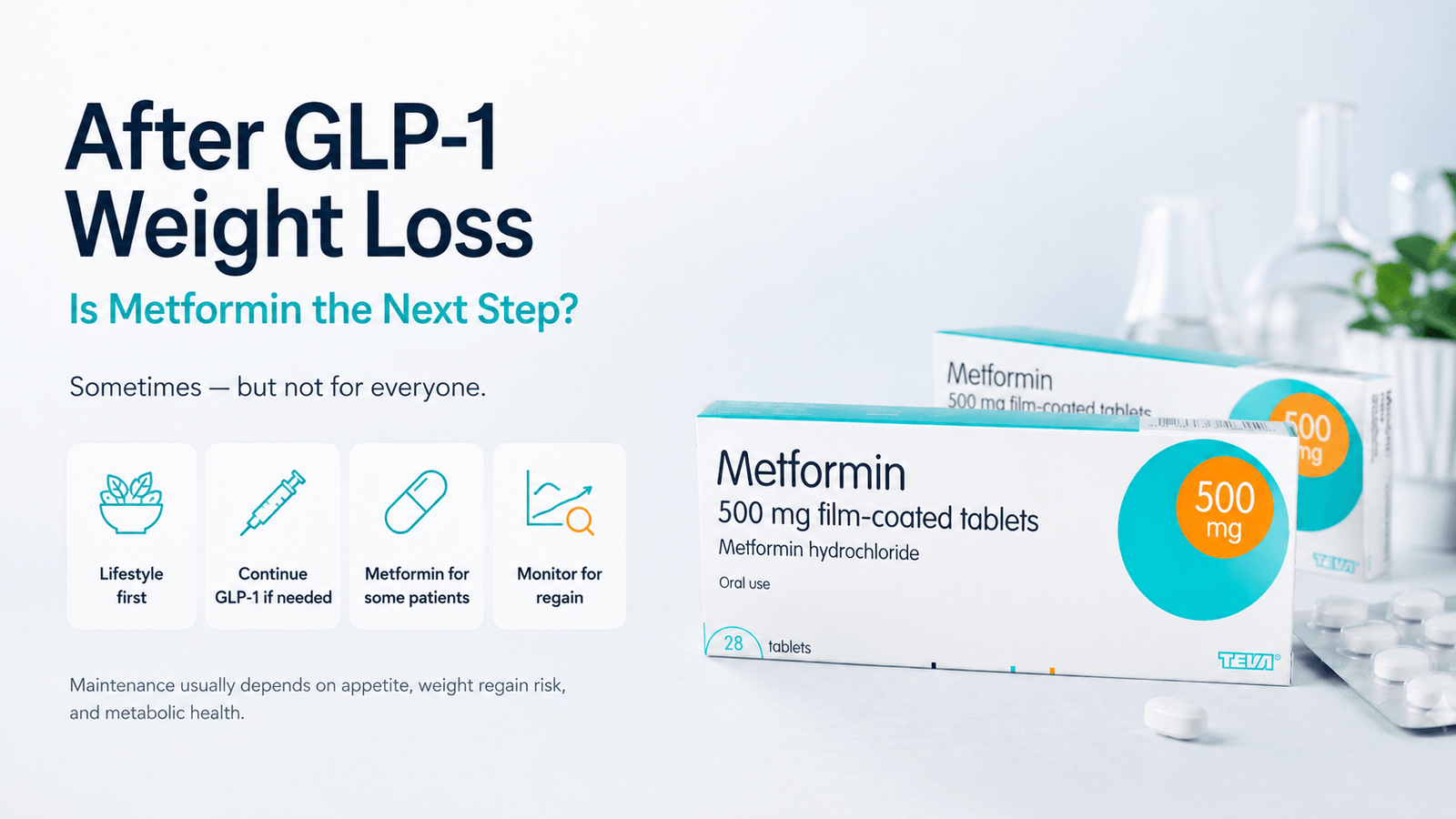
Metformin is one of the oldest, cheapest and most widely used medicines in the world. It is mainly a type 2 diabetes drug, but it also produces modest weight loss and, importantly, has a strong track record for keeping modest weight off over the long term.
Because of that, some people use metformin as a lower-cost bridge when they step down from or stop a GLP-1, to help blunt the rebound in appetite and weight. It will not match the power of a GLP-1, and the direct evidence for using it specifically after these injections is still developing, so it is not a magic replacement. But it is inexpensive, generally well tolerated, and for the right person it can be a sensible part of a maintenance plan. It is a prescription medicine, so it is a conversation to have with our pharmacist or your GP. One thing worth knowing: long-term metformin can gradually lower your vitamin B12, so it is wise to keep an eye on your levels, and we offer B12 injections at the pharmacy if you need a top-up.
The lifestyle that keeps it off
Whatever you decide about medication, these habits are the foundation. They are what turns short-term weight loss into a lasting change.
- Protein first. Aim for a good source of protein at every meal to protect muscle and keep you full.
- Strength train two to three times a week. The single best way to hold on to muscle.
- Keep moving. Aim for regular activity most days, on top of your training.
- Mind your sleep and stress. Both drive appetite and cravings when they slip.
- Watch for food noise returning as the dose comes down, and have a plan for it before it hits.
- Keep a light touch on the scales. A weekly weigh-in catches small regains before they become big ones.
Build your maintenance plan
Tap the habits you can genuinely commit to.
Alternative and step-down medications
Coming off a strong GLP-1 does not have to be all or nothing. Depending on your goals, budget and how your body responds, options include:
| Option | Where it can help |
|---|---|
| A lower maintenance dose of your current medicine | Often enough to hold results at a lower monthly cost. Needs monitoring to find your lowest effective dose. |
| Switching GLP-1 (for example between semaglutide and tirzepatide, or to daily liraglutide) | Different strength, cost or tolerance may suit you better for the maintenance phase. |
| Metformin | Low-cost bridge that may help blunt regain for some people. Modest effect. |
| Naltrexone and bupropion (a combination weight-management tablet) | Works on appetite and cravings. Modest effect, not for everyone. |
| Lifestyle alone, with support | Possible for some after a period of stability, but regain risk is higher without a safety net. |
New options are also on the way, including oral GLP-1 tablets and even more powerful combination medicines, so the maintenance toolkit is only going to grow.
A practical long-term plan
Here is the approach we take with patients who have reached their goal:
- Decide before you taper. Choose your path, stay, step down or stop, with a clinician, rather than drifting into it.
- Come down gradually. If you are reducing or stopping, taper the dose rather than quitting overnight, to soften the rebound in appetite.
- Lock in the foundations first. Protein, strength work and sleep should be solid before you cut the dose.
- Consider a bridge. Ask whether metformin or a lower maintenance dose fits your situation.
- Keep checking in. Regular reviews of your weight and health markers catch regain early, when it is easiest to act.
Plan your next step with our pharmacist
Reached your goal, or getting close? We will help you protect what you have worked for, whatever you decide about medication.
Frequently asked questions
Will I put the weight back on if I stop Ozempic or Mounjaro?
Most people regain a large share, often about two-thirds within a year, if they stop with no maintenance plan. Tapering gradually, protecting muscle with protein and strength training, and considering a lower dose or a bridge medicine all reduce that risk.
Do I have to stay on a GLP-1 forever?
Not necessarily, but obesity is a long-term condition, so many people do stay on some form of treatment. Others step down to a lower dose or come off with a strong lifestyle plan. The right answer is individual, and worth deciding with a clinician.
Can metformin help me keep the weight off?
Metformin is a low-cost medicine with a good record for modest, lasting weight control. Some people use it as a bridge when reducing a GLP-1. It is milder than the injections and the evidence for this specific use is still developing, so it is best discussed with our pharmacist or your GP.
What is the most important lifestyle change for keeping weight off?
Protecting your muscle. Eating enough protein and doing regular strength training keeps your metabolism up and makes regain far less likely.
References
- Wilding JPH, et al. Weight regain and cardiometabolic effects after withdrawal of semaglutide (STEP 1 extension). Diabetes, Obesity and Metabolism, 2022.
- Rubino D, et al. Effect of continued weekly semaglutide vs placebo on weight loss maintenance (STEP 4). JAMA, 2021.
- Aronne LJ, et al. Continued tirzepatide for maintenance of weight reduction (SURMOUNT-4). JAMA, 2024.
- Diabetes Prevention Program Research Group. Long-term effects of metformin on weight. Diabetes Care.
- HSE and manufacturer prescribing information for semaglutide, tirzepatide and metformin.
Related reading: Keeping the weight off after Ozempic or Wegovy and What to eat and supplement on Ozempic or Mounjaro.
This article is general information from our pharmacy team and is not a substitute for individual medical advice. Please talk to our pharmacist or your GP about what is right for you.