- Most warts and verrucas need more than one freezing session, and some do not respond at all.
- Guidance suggests repeating freezing every two to four weeks, up to a maximum of about six treatments.
- Hand warts tend to respond better than verrucas on the sole of the foot.
- Older warts, adult warts and a weakened immune system can all mean slower clearance.
- If a wart has not improved after about four to six sessions, it is worth reviewing the plan.
How many sessions does wart freezing usually take?
There is no fixed number, and nobody can promise a wart will go after one visit. The HSE notes that freezing may take a few sessions, and the British Association of Dermatologists (BAD) leaflet on verrucas says several freezes may be needed and freezing does not always work.
The BAD guidelines for doctors describe standard practice as repeating freezing every two to three weeks until the wart clears, up to a maximum of about six treatments.
So plan for a short course of wart freezing sessions rather than a single appointment.
| Source | Gap between sessions | Number of sessions |
|---|---|---|
| BAD guidelines (2014) | Every two to three weeks | Until clear, up to about six |
| BAD plantar warts leaflet (2022) | Ideally every three to four weeks for verrucas | Several may be needed |
| UK verruca trial (2011) | Every two to three weeks | Up to four |
| Dutch primary care trial (2010) | Every two weeks | Results checked at 13 weeks |
| HSE (reviewed 2026) | Not stated | May take a few sessions |
Why some warts need more sessions than others
Several things affect how a wart responds:
- Where it is. The BAD guidelines say freezing generally works better on hand warts than on verrucas on the sole, probably because the thicker layer of hard skin on the foot stops treatment reaching the deeper skin.
- How long you have had it. In a Dutch study, about 40 to 50% of verrucas present for under six months had cleared at 13 weeks across all groups, against about 10% of those present for six months or more.
- Your age. The BAD guidelines say warts in adults can be much slower to clear than in children, and that adult warts lasting five to ten years are not unusual.
- Your immune system. A weakened immune system usually makes warts last longer, and BAD says treatment can be less successful if an illness or medicine affects your immunity.
None of this research looked at the CryoPen specifically, so treat these figures as a general guide.
How far apart should sessions be?
The BAD guidelines suggest every two to three weeks, and the BAD verruca leaflet suggests every three to four weeks. That is why we usually book sessions two to four weeks apart, and the pharmacist will suggest a gap that suits you.
The BAD guidelines report that most, but not all, studies found freezing every two to three weeks gave better clearance at three months than freezing every four weeks. Results at six months were often similar, which suggests the total number of sessions may matter more than the exact gap between them.
What happens at each session
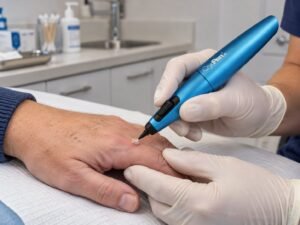
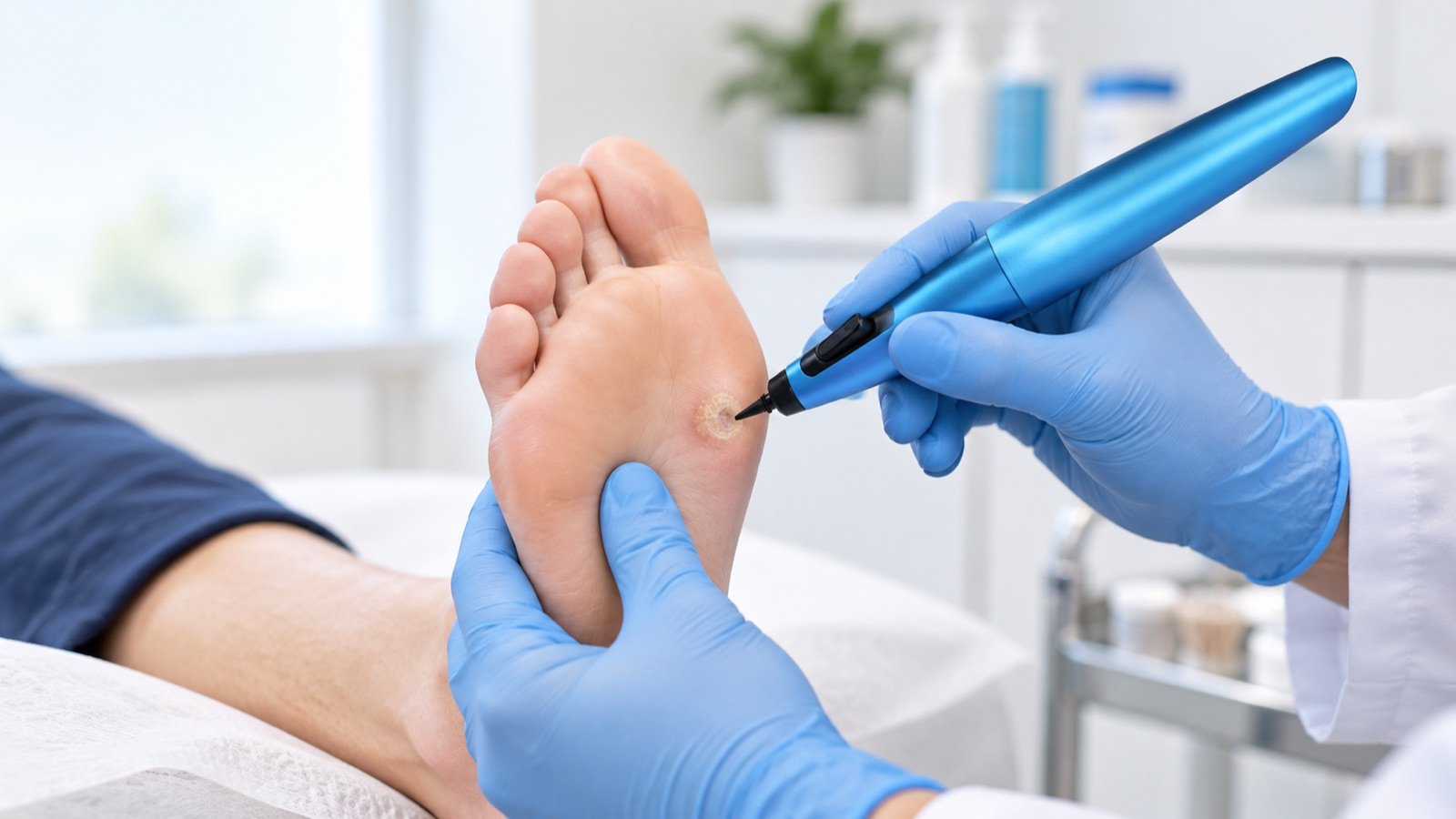
Each session lasts about 20 minutes and is carried out by a PSI-registered pharmacist. It starts with the pharmacist looking at the wart and checking that freezing is suitable for you. If it is not, you will be advised on other options.
The hard skin on a verruca matters too. The BAD guidelines say paring before freezing can improve results for verrucas, though not for hand warts, and the BAD verruca leaflet says thick warts need to be shaved down so the cold can get into the skin.
Freezing can sting, and a blister may form afterwards. Read more on our page about wart and verruca freezing in Portlaoise.
Looking after the skin between sessions
The BAD cryotherapy leaflet advises:
- Keep the area dry for 24 hours, then wash it gently and pat it dry.
- You can apply petroleum jelly daily.
- Do not pick the scab, as this encourages scarring.
- Only burst a blister after getting medical advice.
- Paracetamol taken for the first 24 hours may ease any discomfort.
A scab usually forms after a few days and can take a few weeks to fall off, sometimes longer on the legs, where healing is slower.
The BAD verruca leaflet says using a salicylic acid product between freezes may help freezing work better, and a Cochrane review suggested that combining the two was more effective than salicylic acid alone. If the pharmacist advises it, a product such as Salactol Collodion 10ml (€6.95) can be used between sessions.
Always read the label and ask the pharmacist before using it, particularly if you have diabetes or poor circulation, and do not use it on your face. See also our tips on how to stop verrucas spreading.
Each CryoPen session costs €50 and lasts about 20 minutes, with the pharmacist’s assessment included. The €20 online booking fee is taken off the price on the day, and if the pharmacist decides freezing is not right for you, you pay only the €20. Most warts need more than one session, usually two to four weeks apart, and some do not respond. The service is for people aged 16 and over, at Lyster Square, Portlaoise.
When to stop and review the plan
Freezing does not work for every wart. The BAD cryotherapy leaflet warns that treatment may fail or the wart may come back, so a different treatment may be needed.
According to the BAD guidelines, only one randomised trial has looked at the total number of treatments. Where warts had not cleared after three months of freezing every three weeks, a further three months showed no clear benefit, though the trial was not ideally designed.
The wider evidence is mixed. A Dutch trial found 49% of common warts had cleared at 13 weeks with freezing, while a UK trial found 14% of verrucas cleared with freezing and 14% with salicylic acid. A Cochrane summary also noted that pooled trials of freezing against placebo did not clearly favour either.
We suggest reviewing things with the pharmacist after about four to six sessions. Leaving a wart alone is also a reasonable choice, since the BAD verruca leaflet says up to 65% of viral warts go away on their own within two years. If you are weighing up options, see our comparison of salicylic acid or freezing for verrucas.
When to see your GP
See your GP rather than continuing with freezing if a wart or verruca:
- keeps coming back
- is large or painful
- bleeds
- grows or changes colour
- is on your face or genitals
- shows signs of infection after freezing, such as increasing pain or pus
We offer wart freezing to people aged 16 and over, so children under 16 should see their GP. The BAD verruca leaflet notes that freezing is not usually recommended in children. Your GP may also prescribe creams or other treatments if freezing has not worked.
Common questions
Will one session be enough to remove my wart?
It is possible, but nobody can promise it. Most warts need more than one session, and the BAD guidelines allow for repeat treatments up to a maximum of about six.
Does wart freezing hurt?
It can sting during treatment and may feel sore afterwards, particularly if a deeper freeze is needed. Painkillers such as paracetamol, taken for the first 24 hours, may ease the discomfort.
How long does a wart take to fall off after freezing?
A scab usually forms after a few days and can take a few weeks to fall off, depending on where the wart is. Healing on the legs can be slower.
Can freezing leave a mark?
Picking the scab encourages scarring, so let it fall off by itself. Lighter or darker patches of skin can occur, particularly in people with darker skin.
What if the pharmacist decides freezing is not right for me?
You pay only the €20 online booking fee. The pharmacist will explain why and advise you on other options, including when to see your GP.
Sources: British Association of Dermatologists guidelines for the management of cutaneous warts (2014), British Association of Dermatologists patient leaflet: Plantar warts (2022), British Association of Dermatologists patient leaflet: Cryotherapy (2022), HSE: Warts and verrucas (reviewed 2026), Cochrane Library summary: Topical treatments for cutaneous warts (2021), Cockayne et al., BMJ (2011), Bruggink et al., CMAJ (2010), NHS Lothian Podiatry: Verrucae (2022)