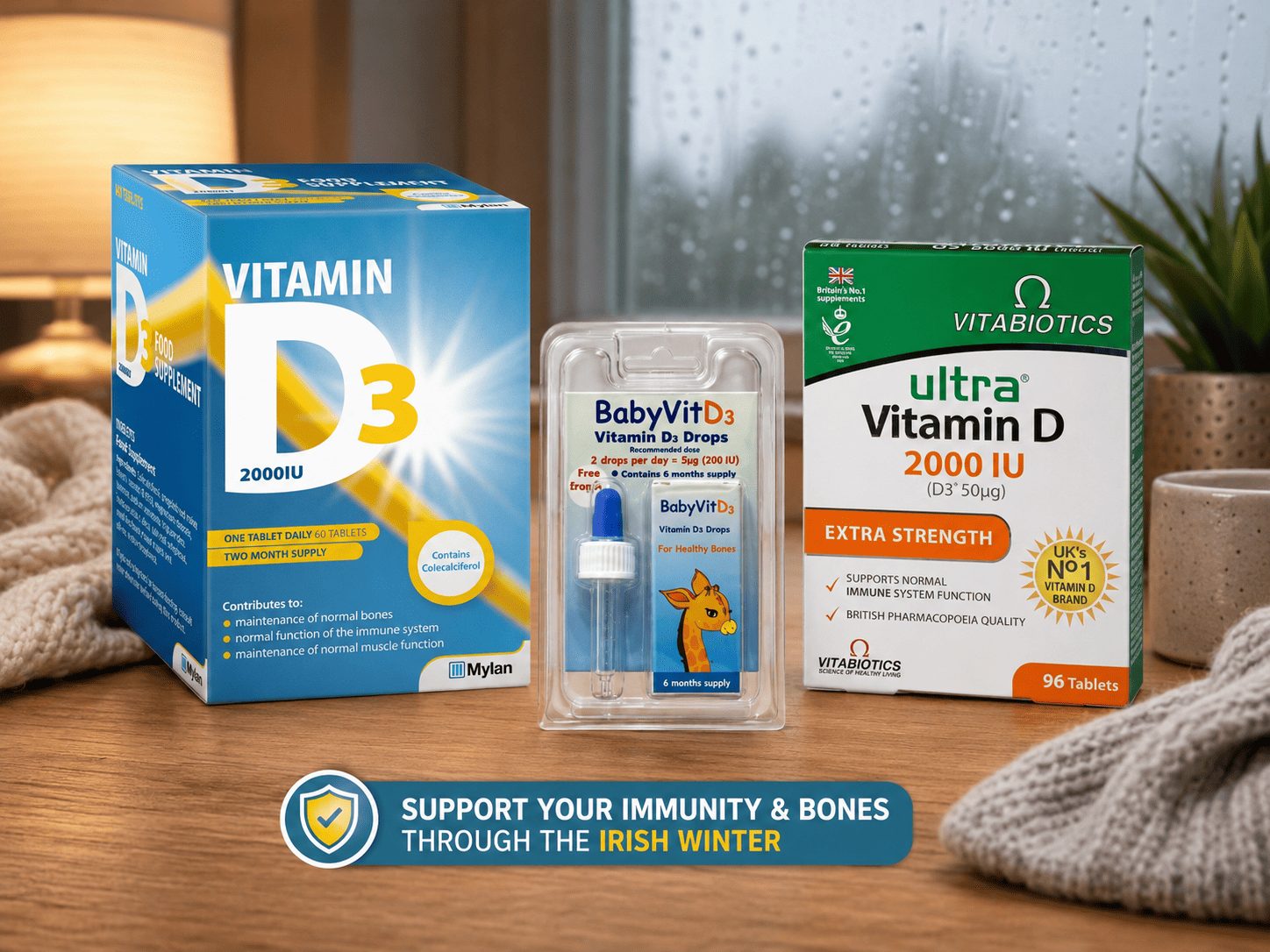
Ireland and sunshine were never a great match. For about half the year the sun here simply is not strong enough for your skin to make any vitamin D at all, which is why so many of us run low by the time spring comes around. It is one of the few supplements worth taking almost across the board, and also one of the few where taking far too much can actually cause harm. Here is the full picture, in plain English.
Why we run low in Ireland
Your skin makes vitamin D when strong sunlight hits it. The catch is that at our latitude, from about October to March, the sun sits too low for that to happen, no matter how long you stand outside [1]. Add in office jobs, cloud, and covering up, and it is easy to see why deficiency is so common here. Irish surveys have found low vitamin D in a large share of adults over winter, and it climbs higher in older people and those with darker skin [1].
What it actually does
Vitamin D helps your gut absorb calcium, which keeps bones and teeth strong and muscles working properly. Run low for a long time and you can get bone and muscle aches, weakness and tiredness. In children a serious shortage causes rickets, and in adults it causes soft, painful bones (osteomalacia). It also plays a part in how your immune system works.
How much do you need?
This is where the Food Safety Authority of Ireland guidance is genuinely useful, because the right amount depends a lot on age [2].
| Age group | Recommended daily amount |
|---|---|
| Babies under 1 | 5 µg (200 IU), every day, all year |
| Children 1 to 4 | 5 µg (200 IU) a day, especially in winter |
| Children 5 to 17 | 10 µg (400 IU) a day in winter |
| Adults 18 to 64 | 15 µg (600 IU) a day, at least October to March |
| Adults 65 and over | 15 µg (600 IU) a day, all year |
| Pregnant or breastfeeding | 15 µg (600 IU) a day |
What the blood levels mean
If you get tested, the result is your 25-hydroxyvitamin D level, measured in nmol/L. As a rough guide, under 30 is deficient, 30 to 50 is on the low side, and above 50 is where you want to be [3]. Not everyone needs a test. It is most worth it if you have symptoms or you are in a higher risk group, and your GP can arrange it.
Can you take too much? The levels that get dangerous
Yes, and this is the part people rarely hear. You cannot overdose from the sun or from food, your body handles that. Toxicity only happens from taking too much in supplement form, usually a high dose for a long time, or by accident [6].
When blood levels stay above about 250 nmol/L, and especially above 375, vitamin D can start to cause harm [6]. The problem is calcium. Too much vitamin D pulls too much calcium into the blood, known as hypercalcaemia. That shows up as nausea, vomiting, constipation, a dry mouth with heavy thirst and frequent weeing, tiredness and confusion, and over time it can lead to kidney stones and kidney damage.
To stay well clear, these are the daily upper limits set for healthy people [4]:
| Age | Do not go above (without medical advice) |
|---|---|
| Babies under 1 | 25 µg (1000 IU) a day. The recommended amount is only 5 µg, so go carefully with drops |
| Children 1 to 10 | 50 µg (2000 IU) a day |
| Children 11 to 17 | 100 µg (4000 IU) a day |
| Adults | 100 µg (4000 IU) a day |
A few people should check first
Most people can take a standard vitamin D supplement safely. But if you have sarcoidosis, certain lymphomas, a history of kidney stones, high blood calcium or kidney disease, vitamin D can push your calcium too high, so only take it on your doctor’s advice. And watch for doubling up. Check whether your multivitamin, a calcium supplement and fortified foods are already adding vitamin D, so it does not stack past the limit.
Does it really do everything they claim?
Vitamin D got talked up as a fix for almost everything, from colds to cancer. The honest picture from the big trials is more modest. The large VITAL study followed over 25,000 adults and found that high-dose vitamin D did not reduce cancer, heart disease or fractures in people who were not deficient to start with [5]. So the sensible takeaway is simple. Vitamin D is essential, and topping up to avoid deficiency is well worth doing, especially through an Irish winter. But megadosing a body that already has enough buys you nothing and carries the risks above. Fix a shortfall, do not chase a super-dose.
Getting some from food and sun
No food gives you loads, but oily fish (salmon, mackerel, sardines), eggs and fortified foods like some milks and cereals all help. From about April to September, a short spell of midday sun on your arms and face a few times a week tops up your stores, just never long enough to burn.
What our staff say at the counter
- The 30 second version: Nearly everyone in Ireland should take vitamin D through the winter. Adults 15 micrograms (600 IU) a day, and babies 5 micrograms (200 IU) every day of the year. Supplements are labelled in IU rather than micrograms, so on the shelf a simple daily dose is roughly 400 to 1000 IU.
- What we stock: Adult tablets in 1000 IU (25 µg), 2000 IU (50 µg) and 3000 IU (75 µg), plus baby drops. The 1000 IU is grand for everyday maintenance, while the 2000 or 3000 IU are handy for building low levels back up over a few months. All three sit safely under the adult limit.
- How much is too much? The daily safe upper limits are 25 µg (1000 IU) for babies, 50 µg (2000 IU) for children aged 1 to 10, and 100 µg (4000 IU) for teenagers and adults. A 2000 or 3000 IU adult tablet is well within that. The risk comes from going high for a long time, or stacking several products on top of each other.
- The one we never skip: Every baby needs 5 micrograms (200 IU) daily, all year, using drops made for infants. Never give a baby an adult supplement.
- When a test is worth it: If you are tired and achy, have darker skin, or are housebound or covered up, a blood test through your GP can be worthwhile.
- Careful if: You have had kidney stones or high calcium, have a word with your doctor before you start.
What we would reach for
The right product really does depend on age. These are the ones we reach for most.
- ✓ In Stock

A quick note on strength: the 2000 IU (50 µg) adult tablets are a common strength and sit well under the 4000 IU safe limit, so they are handy for building low levels back up. For simple day to day maintenance, 600 to 1000 IU is plenty, so ask us which makes sense for you.
References
- Food Safety Authority of Ireland (FSAI). Vitamin D: scientific recommendations for 5 to 65 year olds and for infants. 2023.
- HSE. Vitamin D advice for babies, children and adults.
- Cashman KD, et al. Vitamin D deficiency in Europe, and Irish winter status. Am J Clin Nutr / studies of Irish adults.
- European Food Safety Authority (EFSA). Tolerable upper intake levels for vitamin D. 2023.
- Manson JE, LeBoff MS, et al. Vitamin D supplements and prevention of cancer, cardiovascular disease and fractures (VITAL). New England Journal of Medicine. 2019 and 2022.
- Marcinowska-Suchowierska E, et al. Vitamin D toxicity, a clinical perspective. Frontiers in Endocrinology. 2018.