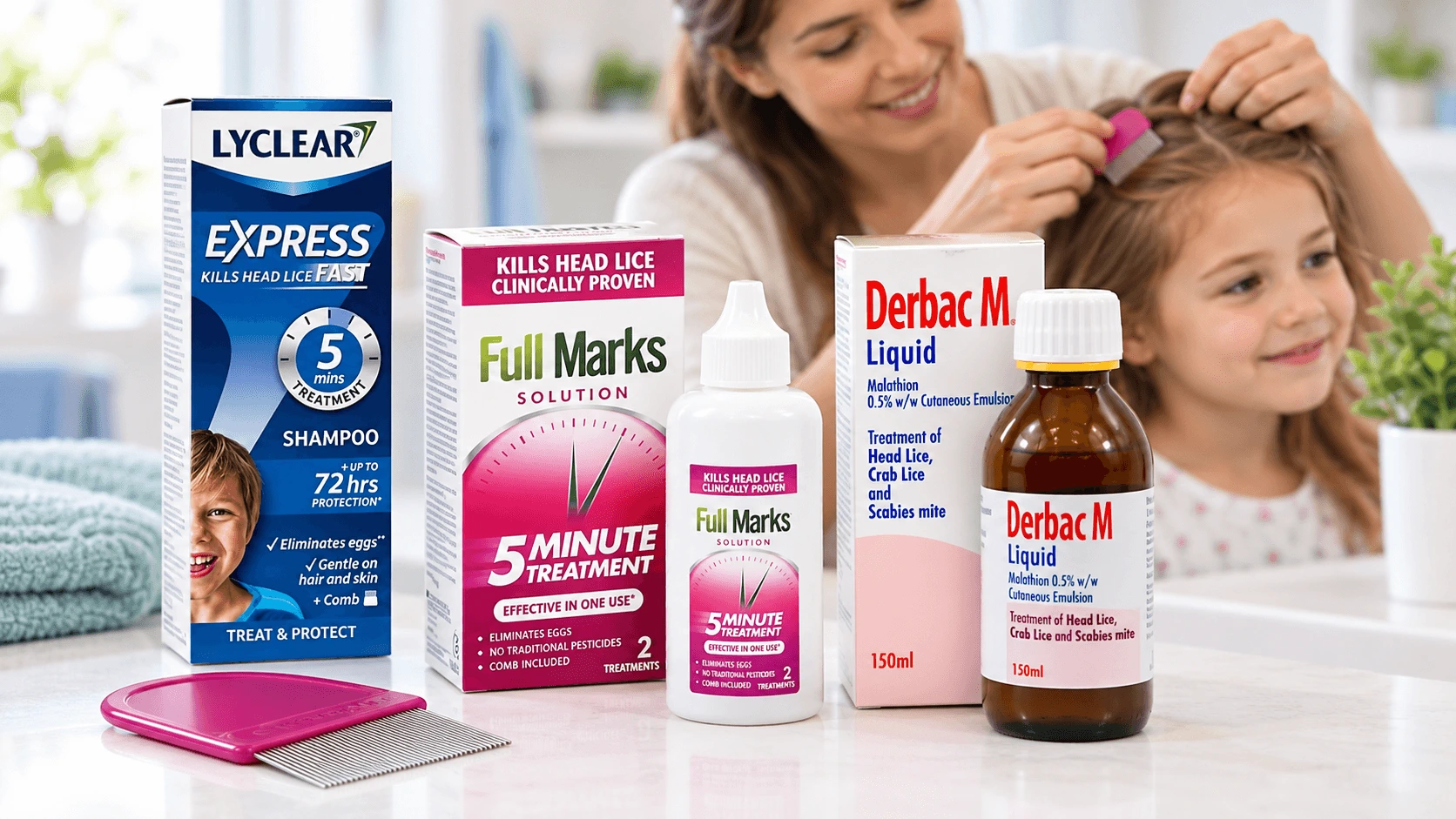
- Head lice are common in school children. They have nothing to do with dirty hair.
- Check with a fine nit comb on wet hair with lots of conditioner. Only treat if you find a live louse.
- Treat everyone with live lice on the same day. Most treatments need a second go around day 7, then a final comb check on day 14.
- Still finding live lice after two weeks and a full course of treatment? Switch to a treatment with a different ingredient, and tell your pharmacist.
- Your child does not need to miss school.
The schools are back, and so are the notes home about head lice. Lice turn up in every kind of family, and a good comb and a simple plan usually clear them. Here’s how to get rid of head lice and nits, step by step, using the latest HSE advice and research.
Head lice and nits: the quick facts
- What they are. Grey-brown insects up to 3 mm long, about the size of a sesame seed. They live only on human heads.
- Eggs and nits. Eggs are glued to hairs near the scalp. Nits are the empty shells, which stay stuck until the hair grows out.
- How fast they breed. Eggs hatch in about 7 to 12 days, and the young lice take another 9 to 12 days to become adults. A female can lay up to 10 eggs a day (American Academy of Pediatrics, 2022).
- How they spread. They can’t jump or fly. They crawl across when heads touch.
- How common they are. Worldwide, about 1 in 5 school children have them, and about 1 in 20 in Europe, according to a 2020 review of 201 studies.
Irish pharmacists estimate that about 1 in 10 children has head lice at any one time. About 8 in 10 cases are children aged 4 to 16 (Irish Pharmacy Union, 2018). Girls are 3 to 4 times more likely to catch them (Children’s Health Ireland, 2025).
Head lice back to school: why they spread in autumn
Most years, Irish Google searches for head lice jump in late August and peak around September. In our look at ten years of Google Trends data for Ireland, September searches ran 68% higher than May on average. In 2026 the busiest week was 27 September to 3 October.
In the second half of 2020, with COVID-19 rules keeping children apart, searches here fell to less than half of the year before. Now children are back side by side, heads together over books and games. The HSE’s leaflet for parents says lice move across when two heads touch for a minute or more.
Mid-term is a good time for a full comb check. For other bugs doing the rounds, see our back to school health checklist and our guide to stopping verrucas spreading.
Got the note from school? Check every head in the house this evening. Only treat someone if you find a live louse, never “just in case”.
How to check for head lice
Looking through dry hair misses most lice. In one study of 304 school children, wet combing found 9 in 10 cases. Looking alone found fewer than 3 in 10.
- Wash the hair and put on lots of ordinary conditioner. It slows the lice down.
- Untangle with a normal comb, then clip the hair into four sections.
- Put the nit comb in at the roots, touching the scalp, and comb slowly to the ends.
- Wipe the comb on white kitchen paper after every stroke and look closely.
- Take extra time behind the ears and at the back of the neck.
- Allow about 10 minutes for short hair and up to 30 for long or curly hair.
What you’re looking for:
- A live louse moves. Only a live louse means you need to treat.
- Live eggs are grey or brown and sit close to the scalp.
- Empty nits are white, yellow or brown and sit further out.
Don’t wait for itching. Only about 1 in 3 children itch, and it can take up to 6 weeks to start (HSE parents’ leaflet, 2017).
Nits or dandruff?
| Check | Nits and eggs | Dandruff |
|---|---|---|
| Feel | Glued to one hair | Loose, brushes away |
| Where | Along the hair, often near the scalp | On the scalp and all through the hair |
| Shape | Small, neat oval | Flat, uneven flakes |
Do nit combs really work? Why the comb matters most
Most treatments kill lice but miss some eggs. In a 2025 lab test of 27 head lice products, only 5 killed all the lice and all the eggs. The comb lifts out what the treatment misses and shows you if it worked, so the HSE says to wet comb in every case.
The HSE leaflet says a nit comb’s teeth should be no more than 0.3 mm apart. Two combs we’d suggest:
- The yellow Ivora comb (some people call it the Ivory comb). A flat plastic comb with very fine teeth, handy for quick weekly checks. It isn’t in our online shop, so ask for it in the pharmacy.
- The Nitty Gritty NitFree metal comb. It has 33 long steel teeth with tiny spiral grooves that grip lice and eggs. The long teeth work in thick or curly hair too.
Metal combs seem better at pulling off eggs. In a small 2007 study of 27 children, a metal comb took out 3 to 4 times more eggs than a plastic one. So use the metal comb on treatment days, and either comb for weekly checks.
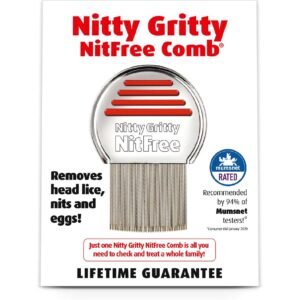
After each use, scrub the comb with an old toothbrush, soak it in hot water and dry it well.
All the ways to treat head lice
Head lice treatments work in a few different ways. That matters, because if one doesn’t work you’ll need to switch to another type.
The HSE’s newest clinical guidance (March 2026) names three coating ingredients as first choice: isopropyl myristate with cyclomethicone (as in Full Marks), dimeticone 4% and octanediol. Older insecticides come second. Other coating products, such as mineral oil and natural-origin ones, work in a similar way but aren’t named in that guidance.
Wet combing on its own
Just conditioner and a good comb, every 3 to 4 days for at least two weeks, until you find no lice 3 times in a row. The HSE’s advice for families is to try this first, and its clinical guidance recommends it on its own for babies under 6 months. It takes patience: in a UK trial, it cleared lice in 57 out of 100 children.
Coating treatments
These coat the lice and dry them out. They don’t poison the lice, so lice are less likely to become resistant to them. Most go on dry hair for 5 to 15 minutes.
- Full Marks (isopropyl myristate with a silicone). It strips the louse’s waxy coat.
- Lyclear (mineral oil): Treatment Shampoo, Express Shampoo and Express Spray. All three go on dry hair, not wet.
- Hedrin Kills Head Lice Naturally (hemisqualane and beeswax, a natural-origin coating). Suitable from 6 months.
- Dimeticone, a silicone. In a 2007 trial it cleared lice in about 7 in 10 people, against about 1 in 3 with malathion. We don’t have a dimeticone product online right now, so ask us in the pharmacy.
- Octanediol, used in some Hedrin sprays. Left on overnight, an octanediol lotion cleared lice in 88 in 100 people in a 2012 trial. These aren’t in our online shop right now, so ask us.
Mousses and plant oils
Vamousse is a mousse that its maker says works with a salt (sodium chloride) solution. It also contains isopropyl alcohol and isopropyl myristate, and the can is flammable. The maker says one treatment is enough, but still do your day 7 comb check. If you find live lice, treat again as the pack says or ask us.
Nitty Gritty Solution is a blend of plant oils that helps the comb glide, and the comb does the real work.
Insecticide medicines: malathion (Derbac M) and permethrin
Two medicines are licensed for head lice in Ireland: malathion (Derbac M) and permethrin (Lyclear Creme Rinse). They’re pharmacy medicines, so you don’t need a prescription, but a pharmacist will check they suit you. Derbac M Liquid is in our online shop. When you order it, you answer a few short questions, and our pharmacist reviews every order before we send it. Derbac M is licensed for the treatment of severe head lice infestation in adults and children aged 6 months and over. It goes on dry hair, stays on for 12 hours or until the next day, and is repeated after 7 days. Lyclear Creme Rinse is not in our online shop, so ask our pharmacist about it. Always read the label.
In many countries, these older medicines no longer kill lice reliably, especially permethrin. A 2023 review found about 8 in 10 lice tested after 2015 were resistant to permethrin-type treatments, up from about 1 in 3 before 2004. That’s why the HSE now lists them second.
Heated air, electric combs and prescriptions
Some clinics abroad use heated-air machines, which killed nearly all eggs in one study. A normal hair dryer won’t do the same, and electric combs have no good trials behind them.
No prescription medicine is licensed for head lice in Ireland. Ivermectin tablets are licensed here for scabies and some worm infections, not head lice. If two different types of treatment have failed, see your GP.
Natural remedies
Tea tree, lavender, olive oil and vinegar all have fans. A 2025 review found that some plant products looked promising, but the studies were small and had weaknesses, so the results are uncertain. The NHS says plant oils are unlikely to work.
Natural isn’t always gentle, either: essential oils can irritate the skin or cause allergies. The American Academy of Pediatrics also says some, such as lavender, might affect hormones in young children. Our Nitty Gritty Solution and Defence Spray contain tea tree and lavender oils among others, so ask us before using them on a young child.
Which treatment should you choose?
Every treatment in our online head lice treatment range works without an insecticide, except Derbac M Liquid (malathion 0.5%), a pharmacy-only insecticide medicine. They use different ingredients, though, and that matters if you need to switch. Times and ages come from the makers’ packs, which can change, so always read the instructions.
| Product and price | Type | Time on hair | From age |
|---|---|---|---|
| Full Marks Solution 100ml, €12.95 | Coating solution | 5 minutes | 2 years |
| Full Marks Solution 200ml, €19.95 | Coating solution, family size | 5 minutes | 2 years |
| Full Marks Solution Spray 150ml, €20.70 | Coating spray | 5 minutes | 2 years |
| Hedrin Kills Head Lice Naturally Lotion 100ml, €14.90 | Natural-origin coating lotion | 5 minutes | 6 months |
| Lyclear Treatment Shampoo & Comb 200ml, €18.90 | Mineral oil shampoo | 15 minutes on dry hair | 2 years |
| Lyclear Express Shampoo & Comb 200ml, €19.95 | Mineral oil shampoo | 5 minutes on dry hair | 2 years |
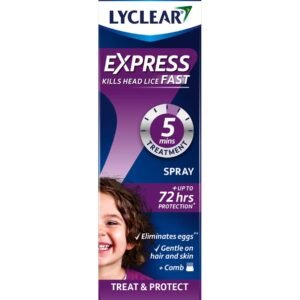
| Lyclear Express Spray & Comb 100ml, €16.40 | Mineral oil spray | 5 minutes | 12 months |
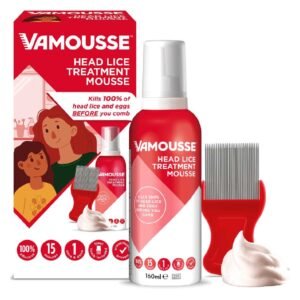
| Vamousse Mousse 160ml, €18.20 | Salt-solution mousse | 15 minutes | 2 years |
| Nitty Gritty Head Lice Solution Kit 150ml, €19.95 | Plant oils to help combing | 20 minutes or more | Ask us under 2 |
| Derbac M Liquid 150ml, €39.95 | Pharmacy-only insecticide medicine (malathion 0.5%) | 12 hours or until the next day, on dry hair | 6 months |
| Nitty Gritty NitFree Comb, €19.95 | Metal nit comb | Use with conditioner | Any age |
| Nitty Gritty Conditioning Defence Spray 250ml, €20.45 | Leave-in conditioner, not a treatment | Leave in | Check the pack |
Quick pointers
- Wriggly child? Pick a 5 minute product.
- Under 2? Hedrin Kills Head Lice Naturally is suitable from 6 months, and Lyclear Express Spray from 12 months.
- Big family or long hair? Full Marks Solution 200ml goes further.
- Asthma or eczema? Ask us first.
We post orders Monday to Saturday for €6 anywhere in the Republic of Ireland, with tracking emailed.
Head lice treatments we stock
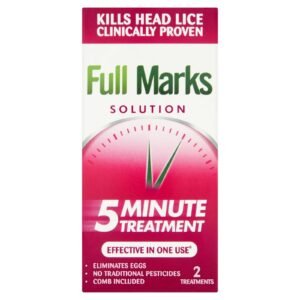 Full Marks Solution 100ml€12.95View
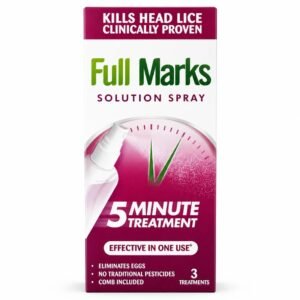 Full Marks Solution Spray 150ml€20.70View
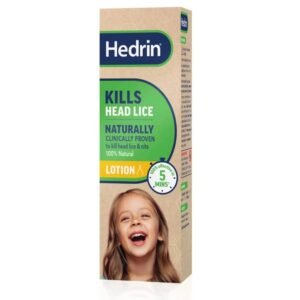 Hedrin Kills Head Lice Naturally Lotion 100ml€14.90View
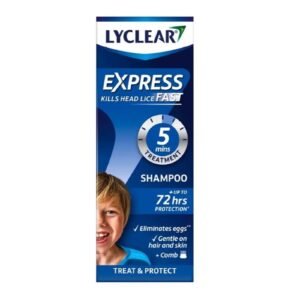 Lyclear Express Shampoo & Comb 200ml€19.95View
 Lyclear Express Spray & Comb 100ml€16.40View
 Vamousse Mousse 160ml€18.20View
How to get rid of head lice: your 2 week plan
On treatment day, check everyone at home and treat everyone with live lice on the same day. Then:
- Read the pack first. Most treatments go on dry hair. If you’ve just done a wet comb check, rinse out the conditioner and let the hair dry fully first.
- Use enough to cover the hair and scalp from roots to tips. Do behind the ears and the back of the neck well. Long or thick hair may need more than one bottle.
- Keep it out of the eyes. A folded towel held over the eyes helps.
- Leave it on for the exact time on the pack. Put it on at the sink or kitchen table, not in the shower.
- Comb out the dead lice and eggs with your nit comb, one section at a time, and wash the product out. Do these in the order your pack says.
The HSE explains that most products kill lice but not eggs. A second go around day 7 catches newly hatched lice before they can lay eggs.
One go is often not enough. In a 2026 trial in Thai schools, more than half the children treated once with a dimeticone gel had lice again by day 9.
| Day | What to do |
|---|---|
| Day 1 | Comb check everyone. Treat anyone with live lice, then comb out. |
| Day 4 | Comb check on wet hair with conditioner. |
| Day 7 | Comb check, then a second treatment if your pack says so. |
| Day 10 | Comb check again. |
| Day 14 | Final comb check. No live lice? Well done. Still finding live lice? Switch treatment (see below). |
Packs differ on day 7. Some always repeat, some only if you still find lice, and a few say up to day 10. Follow your pack.
Wet combing only? Comb on days 1, 5, 9 and 13, then do a final check on day 17.
However you treat, keep up a quick comb check once a week for a month afterwards.
Want the dates worked out for you? Build your own plan below and add the reminders to your phone.
Build your head lice plan
Pick the day you found a live louse and the treatment you are using. You will get a simple plan with dates, and you can add the reminders to your phone calendar.
This plan is a guide. Always read the instructions on your pack, because timings can differ between products. Check everyone in the house on Day 1. Questions? WhatsApp our pharmacists on 085 840 7548 or call 057 866 1999.
Still finding live lice after two weeks? Switch treatment
Before you switch, check the usual slip-ups:
- the second treatment was missed or late
- too little product was used
- it was washed off too soon
- someone close still has lice
Old nits can stay stuck to the hair for months, so finding them doesn’t mean the treatment failed. Only a louse that moves counts.
Give one treatment a fair go first: the full course on the pack, usually two treatments about 7 days apart, with comb checks in between. Still finding live lice after two weeks? Switch to a treatment with a different ingredient, and tell your pharmacist. Don’t keep buying the same product.
The leaflet for Lyclear Creme Rinse, a licensed lice medicine, gives the same advice after 14 days. The HSE’s 2026 guidance says to use a different type of treatment for the next course if lice seem resistant.
It matters more than it used to. In 2023, UK researchers found lice that survived coating treatments, in a few homes where three products had already failed (British Journal of Dermatology).
To switch, pick a different ingredient:
- Full Marks (isopropyl myristate and silicone)
- Lyclear Treatment Shampoo or Lyclear Express (mineral oil)
- Hedrin Kills Head Lice Naturally (natural-origin coating)
- Vamousse (salt-solution mousse). It also contains isopropyl myristate, like Full Marks, so after Full Marks, Lyclear or Hedrin Kills Head Lice Naturally is the clearer change.
- Derbac M Liquid (malathion 0.5%), a pharmacy-only insecticide medicine. HSE guidance lists malathion as a second choice, after physical treatments that coat the lice.
So if Full Marks didn’t clear them, try a Lyclear product, or the other way round. Keep combing. If a second type also fails, Derbac M Liquid (malathion 0.5%), a pharmacy-only insecticide medicine, may be an option. We ask a few short questions when you order, and our pharmacist reviews every order before we send it. You can also see your GP. Always read the label.
How to stop head lice coming back
No product can fully stop head lice, and you should never use a treatment “just in case”, as it can irritate the scalp. A weekly wet comb check helps most.
Once they’re cleared, you could try Hedrin Protect & Go spray to help prevent them coming back. It’s now sold as Hedrin Prevent Lice. It’s a leave-in conditioning spray, not a treatment, and you use it after each hair wash or at least twice a week.
The proof is thin: one small trial of 63 children, paid for by the maker, found some protection with regular use. The HSE doesn’t recommend sprays for keeping lice away, so keep up your weekly comb check. It isn’t in our online shop today, so ask us in the pharmacy. Always read the instructions.
If you’d rather order online, we stock Nitty Gritty Conditioning Defence Spray (€20.45). It’s a leave-in conditioner with plant oils that its maker says helps keep lice away. We found no published trial of it, and it won’t treat lice that are already there. Always read the instructions.
School and home tips
- No need to keep your child home. The HSE and Children’s Health Ireland both say so.
- Tell the school or crèche and close friends’ parents. Irish school health guidance (HPSC) says to sit out Gaelic football, hurling and rugby until treatment is done and there are no live lice.
- Check everyone at home, adults too.
- No deep-clean needed. Lice usually die within a day or two off the head, and one study found live lice on only about 4 in 100 pillowcases. Hot-wash pillowcases and soak combs and brushes in hot water.
- Tie long hair back while lice are going around, and don’t share brushes.
Head lice myths and facts
| Myth | Fact |
|---|---|
| Lice jump or fly. | They only crawl, from head to head. |
| Lice mean dirty hair. | They live in clean or dirty hair. |
| Pets spread lice. | Head lice live only on people. |
| Nits mean lice. | Only a live louse counts. In one study, only about 1 in 3 children with nits had live lice. |
| Chlorine in the pool kills lice. | It doesn’t. |
| A treatment now and then keeps lice away. | It doesn’t, and it can irritate the scalp. |
When to see a pharmacist or GP
Ask our pharmacist before treating if:
- your child is under the age on the pack (under 6 months, use combing only)
- you’re pregnant or breastfeeding (if you’re pregnant, the HSE also says to talk to your GP, midwife or obstetrician first)
- the person being treated has epilepsy, or an allergy to wheat, plant oils or fragrance (some products contain wheatgerm oil, essential oils or geraniol)
- your child has asthma or eczema, or a scalp broken from scratching
See your GP if:
- the scalp looks infected: sore, red, oozing or smelly (Children’s Health Ireland)
- you still find live lice after two different types of treatment
WhatsApp our pharmacists on 085 840 7548 or call 057 866 1999.
Your head lice checklist
Screenshot it or print it for the fridge.
- Nit comb: yellow Ivora or Nitty Gritty NitFree
- Conditioner and white kitchen paper
- Everyone at home checked on day 1
- Day 1: treated and combed
- Day 4: comb check
- Day 7: second treatment or check, as the pack says
- Day 10: comb check
- Day 14: final check
- Still live lice? Switch to a different ingredient and tell us
- School told, pillowcases washed
- Weekly comb check for a month
Common questions
Can my child go to school with head lice?
Yes. The HSE says there is no need to stay off school or crèche. Start treatment that evening and let the school know. Irish school health guidance (HPSC) says to sit out Gaelic football, hurling and rugby until treatment is finished and there are no live lice.
What causes head lice?
Head lice spread when one head touches another, usually for a minute or more. They cannot jump or fly, and they have nothing to do with dirty hair. Children catch them most because they play and learn so close together.
What are the first signs of head lice?
An itchy scalp, often behind the ears and at the back of the neck. But only about 1 in 3 children itch, and it can take up to 6 weeks to start. A wet comb check is how you know for sure.
Does finding nits mean my child has head lice?
Not always. Only a live louse means your child has head lice right now. Empty nits stay glued to the hair for months after the lice are gone.
How do you get rid of nits?
Comb them out. Put plenty of conditioner on wet hair and work through it section by section with a fine nit comb. Metal combs seem better at pulling off eggs. Empty nits do not mean your child still has lice, and any you miss will grow out with the hair.
What kills head lice quickly?
Most coating treatments in our range go on dry hair for 5 to 15 minutes before you comb and wash them out. They kill lice but can miss some eggs, so do the second treatment when your pack says, usually around day 7, and keep wet combing. Always read the instructions.
What is the strongest head lice treatment?
There is no single strongest head lice treatment. Treatments work in different ways, and the right one depends on what you have already tried. HSE guidance lists physical treatments, which coat lice and dry them out, as the first choice, and insecticide medicines such as malathion as a second choice. If you used a physical treatment properly, including the second application your pack asks for, and still find live lice, HSE guidance says to use a different type for the next course. Derbac M Liquid (malathion 0.5% w/w) is a pharmacy-only insecticide medicine licensed for the treatment of severe head lice infestation in adults and children aged 6 months and over. It may be an option when physical treatments have not worked. We ask a few short questions when you order, and our pharmacist reviews every order. Always read the label.
Is it better to use a nit comb on wet or dry hair?
Wet hair, with plenty of ordinary conditioner. It slows the lice down and helps the comb glide. In one study, wet combing found 9 in 10 cases, while looking alone found fewer than 3 in 10.
How do I know the head lice are gone?
Do a slow wet comb check with conditioner on day 14, or on day 17 if you are using wet combing only. If you find no live lice, the treatment has worked. Old nits left on the hair do not mean the lice are back. Keep up a weekly comb check for a month.
Can head lice live on pillows or in your bed?
Not for long. Off the head, lice usually die within a day or two. Hot-wash pillowcases and soak combs and brushes in hot water. You do not need to deep-clean the house.
Can adults get head lice?
Yes, often from children at home. Check everyone in the house and treat everyone with live lice on the same day. If you are pregnant or breastfeeding, talk to your pharmacist, GP or midwife first.
Why do head lice keep coming back?
Usually the second treatment was missed, too little product was used, or someone close still has lice. Still finding live lice after two weeks and a full course of treatment? Switch to a treatment with a different ingredient and tell your pharmacist.
Can a spray stop head lice coming back?
Nothing fully prevents head lice, and the evidence for sprays is limited. Once they are cleared, you could try Hedrin Prevent Lice spray, which used to be called Hedrin Protect & Go. Keep up a weekly comb check too. It is not in our online shop, so ask us in the pharmacy. Always read the instructions.
Not sure which treatment to use?
Ask our pharmacists. WhatsApp us on 085 840 7548, call 057 866 1999 or call in to 1 Dunamaise House, Lyster Square, Portlaoise. We post orders Monday to Saturday for €6 anywhere in the Republic of Ireland, with tracking emailed.
This guide follows HSE advice, the HSE’s clinical guidance on head lice (March 2026) and the research listed below. It is general information, so if you’re unsure, ask us before you buy.
Sources: HSE, Head lice and nits (2024); HSE AMRIC, Headlice clinical guidance V3.0 (March 2026); HPSC, Management of Infectious Disease in Schools (2014); Children’s Health Ireland, Head lice leaflet (2025); HSE, Head lice parents’ leaflet (2017); Irish Pharmacy Union via IrishHealth.com (2018); HPRA, Lyclear Creme Rinse and Derbac M product information (2024); NHS (UK), Head lice and nits (2024); American Academy of Pediatrics, Head lice (2022); makers’ leaflets and FAQs for Full Marks, Hedrin, Lyclear, Nitty Gritty and Vamousse (2026); Hatam-Nahavandi et al. (2020, PMID 32803332); Jahnke et al. (2009, PMID 19289764); Hill et al. (2005, PMID 16085658); Speare et al. (2007, PMID 18173523); Speare et al. (2003, PMID 12890107); Burgess et al. (2007, PMID 17987114); Burgess et al. (2012, PMID 22523593); Burgess et al. (2014, PMID 24879825); Burgess and Brunton (2023, PMID 37015895); Abbasi et al. (2023, PMID 37408932); Toubate et al. (2025, PMID 40704278); Chen et al. (2025, PMID 40674396); Vannaratha et al. (2026, PMID 42480517); Dörge et al. (2017, PMID 28155106); Goates et al. (2006, PMID 17079567); Google Trends, Ireland (2016 to 2026).